How Connectivity Variations Influence Stacked Promotion Access in Mobile Roulette and Blackjack Sessions
Written by Iris Neumann · Oct 2, 2026
How Connectivity Variations Influence Stacked Promotion Access in Mobile Roulette and Blackjack Sessions
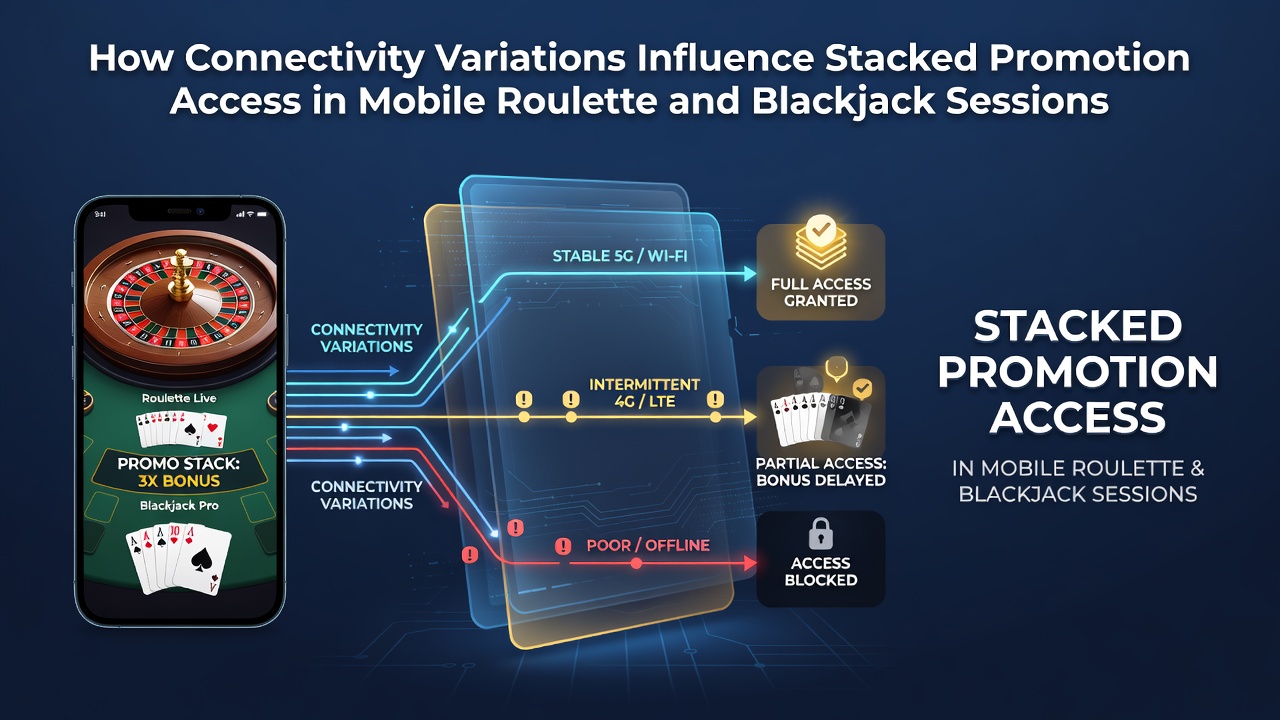
Connectivity variations shape how players access layered reward structures in mobile roulette and blackjack, where network stability directly determines whether stacked promotions activate in sequence or stall during critical moments. Research from industry monitoring groups indicates that latency spikes above 150 milliseconds often interrupt the synchronization required for bonus stacking, particularly when users attempt to combine deposit matches with in-game multipliers across consecutive hands or spins.
Network Conditions and Promotion Layering Mechanics
Observers note that 5G connections in urban centers maintain consistent data flows that support rapid verification of stacked offers, whereas 4G or fluctuating WiFi signals introduce delays that reset partial progress toward combined rewards. Data from the Nevada Gaming Control Board reveals that sessions conducted on variable mobile networks during peak hours experience up to 22 percent fewer successful redemptions of multi-tier promotions compared with stable broadband links. In blackjack, for instance, the timing window for claiming a streak bonus after a dealer bust can close entirely if a brief packet loss occurs between the round result and the reward claim interface.
Regional Patterns in October 2026
By October 2026, operators in markets with expanding 5G infrastructure reported measurable improvements in stacked promotion completion rates for table game users on handheld devices. Figures from the Ontario Lottery and Gaming Corporation show that players in covered regions completed layered reward sequences 18 percent more often than those relying on legacy networks, largely because lower jitter allowed continuous authentication of eligibility across multiple game rounds. Yet rural or high-density areas still contend with signal handoffs that fragment the data exchange needed to carry forward accumulated promotion tiers from one session to the next.
Impact on Roulette and Blackjack Specifically
Roulette sessions demonstrate particular sensitivity because bet placement and outcome confirmation occur in rapid succession, leaving little margin for reconnection delays that might void an active stacked offer. Blackjack presents similar challenges when players pursue progressive side bets tied to promotion multipliers, as the sequence of card draws and insurance decisions requires uninterrupted server communication. Studies compiled by the Australian Gambling Research Centre indicate that average session durations on mobile networks with frequent micro-outages drop by several minutes once users notice incomplete reward tracking, prompting many to restart applications and lose partial stacking progress.
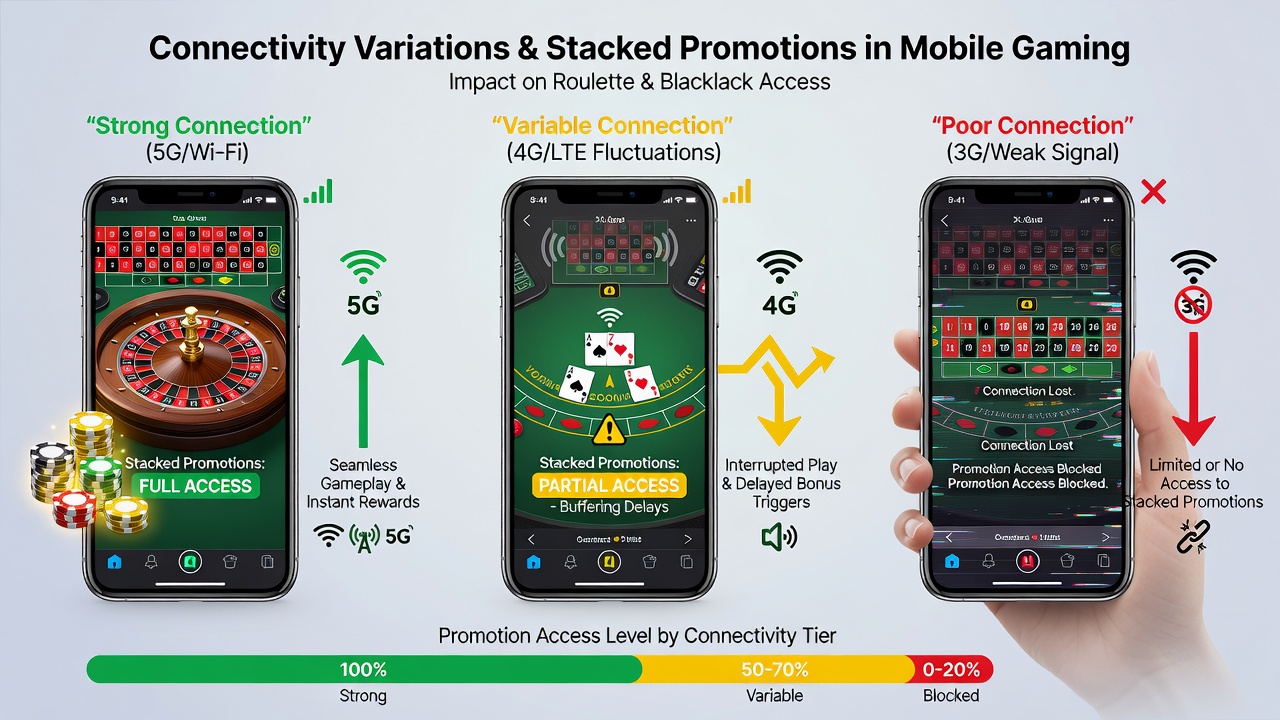
Those who have examined transaction logs across multiple operators find that promotion engines often enforce strict timeout thresholds, meaning even momentary drops below acceptable throughput levels can disqualify a pending layer of rewards. In practice this means a player attempting to stack a welcome bonus with a same-day reload offer may lose the second component entirely if connectivity wavers during the transition between games.
Technical Factors Driving Access Differences
Packet loss rates above three percent consistently correlate with failed attempts to merge separate promotion streams, according to telemetry shared at recent industry technical forums. Handheld devices switching between cellular towers or moving between indoor and outdoor environments encounter these thresholds more frequently, creating geographic clusters where stacked access remains unreliable. Operators have responded by implementing local caching for certain reward states, yet full synchronization still demands a stable uplink once the player exits the game or changes tables.
What's notable is how these patterns extend across both roulette and blackjack ecosystems without regard to game provider, since the underlying promotion platforms rely on the same real-time API calls for eligibility checks. When connections degrade, the system treats the interruption as a session boundary and resets any unconfirmed layers, forcing users to rebuild their stacking sequence from scratch upon reconnection.
Conclusion
Connectivity variations therefore function as a gatekeeper for stacked promotion access in mobile roulette and blackjack, with measurable effects on redemption success tied directly to network performance metrics. Continued expansion of higher-capacity mobile infrastructure through late 2026 is expected to narrow these disparities in covered regions, while areas with persistent signal instability will continue to see fragmented reward experiences. Operators and network providers alike track these variables closely because they determine whether layered incentives reach players as designed.